CGP 9.0
CALL FOR RESEARCH IDEAS
RASTA – PIDE & Planning Commission Competitive Research Grants
Research that informs Pakistan's Economic Transformation
- 120 research projects awarded
- PKR447m in research grants
Objectives
-
1
Reduce the research-policy gap by stimulating economic and social science research and debate across Pakistan.
-
2
Provide a knowledge-sharing and generating platform where different actors can present and share evidence-based research to inform decision-making in government.
-
3
Revisit the public policy agenda in line with the evidence produced in this programme.
-
4
Build capacity and improve policymaking and implementation by involving and engaging local universities, think tanks, policymakers, practitioners and other stakeholders.
With these objectives, the programme seeks to develop local thought communities and generate knowledge. Substantial outputs will be completed in critical areas of public policy, producing insightful research that helps achieve the Government’s goals in line with its vision.
CGP 9.0
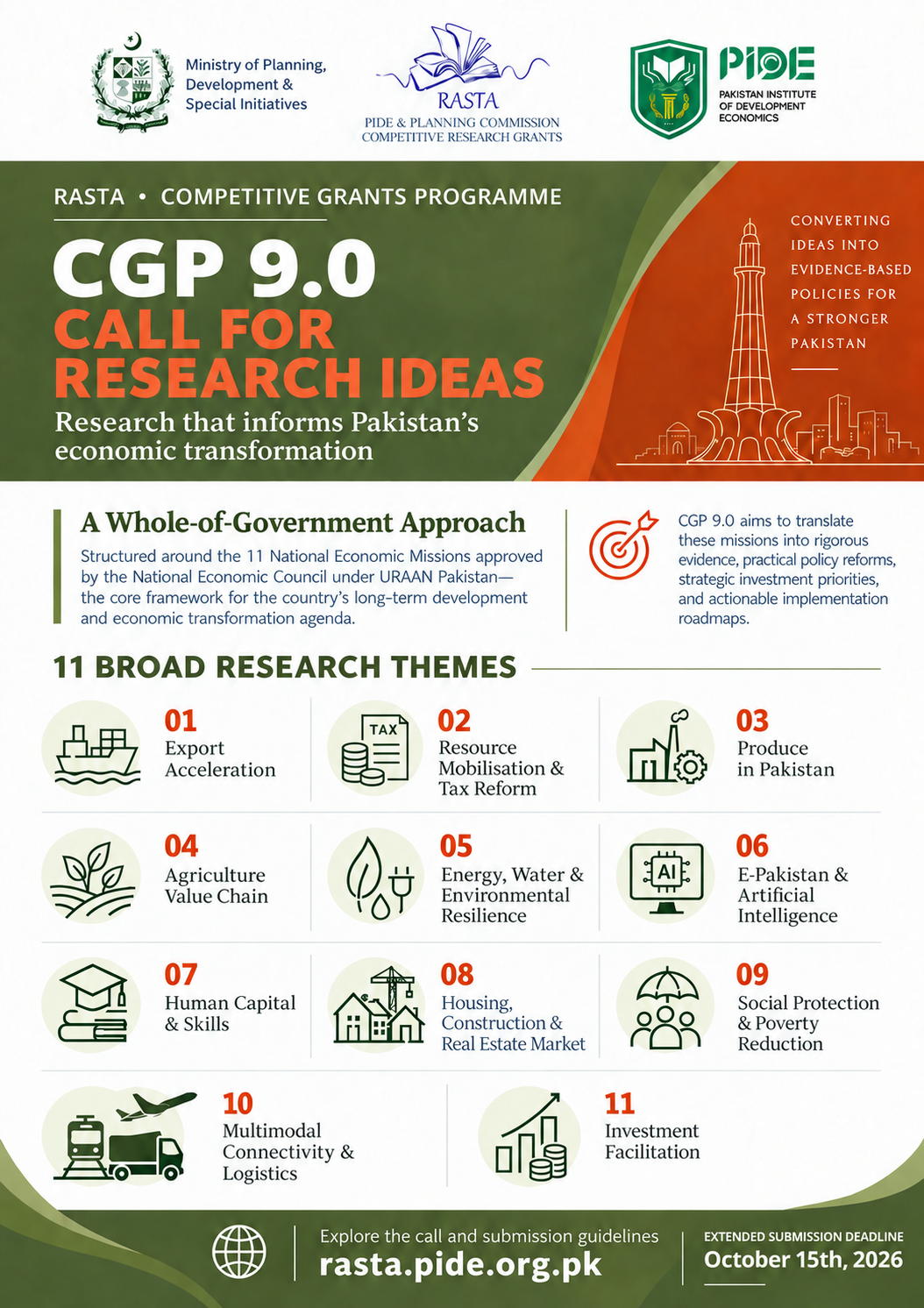
This is the ninth call for the Competitive Grants Programme. CGP 9.0 translates the 11 National Economic Missions approved by the National Economic Council (NEC) under the URAAN Pakistan vision into evidence-based reforms, strategic investment priorities and actionable implementation roadmaps.
Research ideas are invited on 11 themes
- 1Export Acceleration
- 2Resource Mobilisation & Tax Reform
- 3Produce in Pakistan
- 4Agriculture Value Chain
- 5Energy, Water & Environmental Resilience
- 6E-Pakistan & Artificial Intelligence
- 7Human Capital & Skills
- 8Housing, Construction & Real Estate Market
- 9Social Protection & Poverty Reduction
- 10Multimodal Connectivity & Logistics
- 11Investment Facilitation
More information is available at rasta.pide.org.pk
RASTA Competitive Grants Programme
CGP9.0
Call for research ideas, CGP 9.0
Research ideas are invited on eleven themes. Proposed studies should identify key policy issues and public policy decisions in Pakistan, assess what those decisions achieved, and recommend better alternatives.
What your study should do
Whichever theme you choose, a strong research idea follows the policy cycle from problem to recommendation.
-
1
Identify the policy issue
Pinpoint a key policy issue and the public policy decisions made on it in Pakistan.
-
2
Assess the outcomes
Measure the empirical outcomes of those decisions.
-
3
Evaluate the constraints
Examine what has held back policy reform.
-
4
Recommend alternatives
Explore alternative policy options that would strengthen impact.
Research themes
Eleven themes, each with five focus areas ending in an implementation roadmap. Open a theme to see its topics, or search across all of them.
1
Export acceleration
Expand export competitiveness, product diversification and global value chain integration across manufacturing, IT, services, minerals and the blue economy.
- 1.1Competitiveness and diversification
Revealed comparative advantage and market diversification from low-value textiles into engineering, pharma, defence and speciality chemicals.
- 1.2Global value chains and upgrading
Productivity, quality certifications, Industry 4.0 adoption, gender-inclusive workforce strategies and SME supply-chain integration.
- 1.3IT and skilled exports
IT/BPO freelancing growth, digitally enabled service platforms and high-skilled labour export strategies.
- 1.4Trade policy and logistics
Tariff rationalisation, anti-export bias elimination, customs automation, export credit guarantees, FX rules, and port and border efficiency.
- 1.5Implementation roadmap
Sub-sector action plans, target matrices and financing feasibility.
2
Resource mobilization and tax reform
Expand the tax base, improve compliance, and build an equitable, digital-first revenue system to generate sustainable fiscal space while strengthening fiscal federalism.
- 2.1Tax base expansion and equity
Capturing under-taxed sectors (retail/wholesale, real estate, agricultural income); distributional and gender-disaggregated impact assessments.
- 2.2Tax administration and digitalisation
FBR and provincial revenue authority automation; mandatory digital invoicing, automated risk audits, and SRO/exemption rationalisation.
- 2.3Federal-provincial fiscal relations
Rebalancing the National Finance Commission framework, harmonising tax assignments, and boosting provincial and local own-source revenues.
- 2.4Political economy and SOE reform
Diagnostics of stalled tax/SOE reforms; political-economy-aware sequencing, debt sustainability modelling and non-tax revenue strategies.
- 2.5Fiscal sustainability roadmap
Medium-Term Revenue Strategy and quantified revenue KPIs.
3
Produce in Pakistan
Increase domestic value addition in manufacturing, strengthen industrial productivity, and reduce dependence on strategic imports.
- 3.1Competitiveness and import substitution
Total factor productivity, cost-of-doing-business analysis, Effective Protection Rate (EPR) rationalisation, and raw/intermediate input import substitution.
- 3.2SME scaling and SEZs
Credit access, formalisation incentives, and diagnostic evaluations and revival blueprints for SEZs and industrial estates.
- 3.3Technology adoption and de-sludging
Manufacturing automation and regulatory audits to eliminate licensing, permit and inspection “sludge”.
- 3.4Industrial policy governance
Governance models for dynamic cluster management, SEZ administration, and evaluation of donor and government industrial schemes.
- 3.5Industrial transformation roadmap
Sector investment plans, domestic value-addition targets and execution timetables.
4
Agriculture value chain
Modernise agriculture into a climate-smart, water-efficient agribusiness sector, boosting yields, post-harvest processing and high-value exports (horticulture, livestock, dairy, fisheries).
- 4.1Productivity and technology
Yield gap remediation, farm mechanisation, digital/precision agriculture and modern extension services.
- 4.2Water efficiency and climate adaptation
Agricultural water productivity, drip/sprinkler adoption, groundwater management and climate resilience.
- 4.3Agro-processing and cold chains
Cold-chain networks, processing facilities and post-harvest loss reduction strategies.
- 4.4Markets, land and credit
Mandi deregulation, price realisation, land fragmentation remedies, gender barriers to land ownership, and agri-credit/insurance.
- 4.5Agri-export and provincial roadmap
Export supply chains meeting international SPS/Halal standards; region-specific commodity roadmaps with provincial co-financing.
5
Energy, water and environmental resilience
Secure energy and water systems while eliminating circular debt and climate vulnerabilities.
- 5.1Power sector restructuring
Addressing circular debt drivers, tariffs, T&D losses, CTBCM market implementation and PPA restructuring.
- 5.2Renewables and efficiency
Cost-effective renewable energy, grid modernisation, storage and energy efficiency.
- 5.3Water security and governance
Water allocation, groundwater management, irrigation efficiency and river-basin governance.
- 5.4Climate and environmental resilience
Addressing floods, droughts, air pollution and smog, urban heat stress, waste and environmental risks.
- 5.5Resilience roadmap
Mobilising public and private finance for integrated energy, water and environmental resilience.
6
E-Pakistan and artificial intelligence
Scale ICT and freelancing exports and operationalise AI to drive digital public infrastructure, public service delivery and enterprise growth.
- 6.1Digital infrastructure and DPI
High-speed broadband, national fiberization, Digital Public Infrastructure, e-commerce integration, fintech payments and cybersecurity.
- 6.2AI for growth and governance
Commercial AI adoption in enterprises and SMEs; AI in public administration, regulatory oversight, predictive policymaking and Quantum Valley readiness.
- 6.3Digital skills and freelance scaling
Digital literacy, advanced AI training, gig worker protections, international payment gateways, IP protection and venture capital deregulation.
- 6.4Policy evaluation
Empirical evaluation of federal, provincial and donor-funded digital economy initiatives.
- 6.5E-Pakistan roadmap
Infrastructure investment sequencing, regulatory reform schedules, adoption metrics and financing plans.
7
Human capital and skills
Convert demographic potential into productive human capital by reducing Out-of-School Children (OOSC), aligning TVET with market demand, and raising female labour force participation.
- 7.1Foundational learning and governance
Tackling learning poverty, teacher accountability, OOSC re-entry models and education governance.
- 7.2Market-oriented TVET
Restructuring TVET curricula for local Industry 4.0 demand and foreign labour export markets.
- 7.3Youth employability and female participation
School-to-work transitions, formal apprenticeships, youth entrepreneurship, and addressing legal, transport and care-economy barriers to women’s employment.
- 7.4Health, nutrition and population
Universal Health Coverage (UHC) sustainability, stunting and malnutrition reduction, climate-health vulnerability mapping and demographic management.
- 7.5Human capital roadmap
Skill demand mapping, provincial delivery plans, quantified targets and medium-term financing models.
8
Housing, construction and real estate market
Expand affordable housing, formalise real estate markets, and modernise urban land policy to make construction a driver of employment and investment.
- 8.1Affordable housing and mortgages
Low-income housing models, rental market frameworks, long-term mortgage liquidity and Islamic credit guarantees.
- 8.2Land titling and urban planning
Digital cadastral mapping, clean land titling, land valuation, vertical zoning deregulation, Transit-Oriented Development and municipal approval de-sludging.
- 8.3Construction productivity and green standards
Alternative low-cost materials, green building standards, climate-resilient construction, and formalising broker and developer markets.
- 8.4Real estate governance and public land PPPs
Streamlining approvals, unlocking public land for private development, and evaluating public housing programs.
- 8.5Housing execution roadmap
City-specific housing supply plans, private capital sourcing and urban land utilisation strategies.
9
Social protection and poverty reduction
Reduce chronic and transient poverty through an integrated, shock-responsive social safety net that creates pathways to productive livelihoods.
- 9.1Poverty measurement and targeting
District-level chronic vs transient poverty mapping, multidimensional poverty analysis, and empirical evaluations of cash transfer programs (e.g., BISP).
- 9.2Shock-responsive safety nets
Systems and social registries to respond rapidly to climate disasters, food inflation spikes and economic shocks.
- 9.3Productive inclusion and graduation
Connecting safety net recipients to skills training, micro-grants, gender-focused livelihood support and formal jobs.
- 9.4Digital safety nets and consolidation
Digital wallet payments, data integration, resolving federal-provincial overlaps, and consolidating duplicative welfare schemes.
- 9.5Poverty reduction roadmap
Quantified poverty trajectories, unified safety net architecture and long-term fiscal plans.
10
Multimodal connectivity and logistics
Lower supply chain logistics costs and transit times to strengthen domestic commerce, regional corridors and export competitiveness by rebalancing freight toward rail.
- 10.1Logistics competitiveness
Logistics cost benchmarking, supply chain bottleneck identification, cargo tracking and technology adoption.
- 10.2Freight rebalancing and transport integration
Shifting long-haul freight from road to rail, mass transit sustainability and multimodal corridor planning.
- 10.3Ports, blue economy and corridors
Port modernisation, blue economy activation, CPEC trade corridor optimisation and maritime connectivity.
- 10.4Border facilitation and customs
Modernising border-crossing infrastructure, single-window systems and digital cargo documentation.
- 10.5Connectivity roadmap
Priority corridor mapping, investment sequencing, institutional coordination, PPP models and financial viability plans.
11
Investment facilitation
Mobilise domestic private capital and attract quality Foreign Direct Investment (FDI) into export-oriented, high-value sectors by creating a predictable, competitive business climate.
- 11.1Investment climate and SIFC optimisation
Reducing administrative burdens, streamlining one-window clearance, policy predictability, and institutional evaluation of the Special Investment Facilitation Council model.
- 11.2Capital mobilisation and FDI linkages
Addressing constraints to private domestic savings conversion, targeting FDI that generates technology transfer, and maximising supplier spillovers.
- 11.3Investor protection and dispute resolution
Alternative Dispute Resolution, specialised commercial courts, legal capital protections, and insulating commercial policies from political volatility.
- 11.4Policy evaluations
Empirical evaluations of past and present investment promotion regimes, tax credits and donor-supported programs.
- 11.5Investment facilitation roadmap
Strategic reform matrices, SIFC investment pipeline execution plans, target metrics and implementation KPIs.
Research ideas (stage 1) are due by 15 October 2026. Submissions close at midnight, Pakistan Standard Time (PST).
Submit a research idea